Tuesday, 31 March 2015

VISIT TO EUROPE - CROATIA - DUBROVNIK - THE CITY AND THE NEW PORT


CHAPPIDI ABHIRATH REDDY
C/O COL GKS REDDY

Secunderabad - 500 015.


Visit to Dubrovnik City and New Harbour


Dubrovnik City


          Dubrovnik (pronounced [dǔbroːʋniːk] ( listen);[2] Italian: Ragusa) is a Croatian city on the Adriatic Sea, in the region of Dalmatia. It is one of the most prominent tourist destinations in the Mediterranean, a seaport and the centre of Dubrovnik-Neretva County. Its total population is 42,615 (census 2011). In 1979, the city of Dubrovnik joined the UNESCO list of World Heritage Sites

          The prosperity of the city of Dubrovnik was historically based on maritime trade. As the capital of the Republic of Ragusa, a maritime republic, the city achieved a high level of development, particularly during the 15th and 16th centuries. Dubrovnik became notable for its wealth and skilled diplomacy

        The beginning of tourism in Dubrovnik is associated with the construction of the Hotel Imperial in Dubrovnik in 1897. According to CNNGo, Dubrovnik is among the 10 best preserved medieval walled cities in the world. Although Dubrovnik was demilitarised in the 1970s to protect it from war, in 1991, after the breakup of Yugoslavia, it was besieged by the Yugoslav People's Army (JNA) for seven months and suffered significant damage from shelling. 


A long shot of Hotel Hilton Imperial, From the City Walls, 
located very close to the Walled City


A closer View of Hotel Hilton Imperial


A frontal view of Hotel Hilton Imperial from across the Road


A Modern building outside the walled city, modeled on the 
old Architecture and Construction Material 


Dubrovnik New Port


          Trade development and the arrival of railway in Dubrovnik required the construction of a new port in Dubrovnik. The old one – where both its position and facilities were concerned - could in no way whatsoever meet the requirements for the construction of a cargo port. Initially a cargo-passenger port, it had one passenger jetty, while the remaining part was constructed as a cargo ship quay with cranes for unloading and loading the ship cargo and the terminal for unloading and loading the railway carriages used for transportation of various goods within the former Yugoslavia.


       The port was intended for the acceptance and further transport of timber, but its later development included the construction of a huge refrigeration plant for the acceptance and storage of highly perishable foodstuffs. A large passenger terminal was also constructed with a restaurant and other facilities. During the Croatian War of Independence and a several-day shelling, the refrigeration plant was completely destroyed, while the passenger terminal was heavily damaged. At that time the port was Dubrovnik's only connection with the world, because the city was completely blockaded.


          In December 2009 a great investment in renovating and expanding the port - which had begun in 2009 - was completed, and the new quay enabled the Port of Gruž to receive three mega-cruisers at the same time. This investment is the first phase of the renovation and modernisation of the Port of Gruž.


          Worth mentioning is that cruise ships often anchor in front of the Isle of Lokrum, also a favourite location for luxurious yachts and sailboats offering a memorable view of the Old City.


A long shot of Dubrovnik New Port (Gruz) from the Balcony of the Hotel Room. 
Two large Ocean Liners berthed at the Port can be seen on the Right and the 
Huge Suspension Bridge at the Entrance of the Port is in the Centre


Another view of Dubrovnik New Port


A Replica of an old Ship, meant for the Tourists, berthed at the Port


A full view of the Replica from the Broad side


Another close view of the Replica


A view of the Fishing Harbour at Port Gruz


A Catamaran Docked at the Port, used for more stability in the 
Turbulent waters around numerous Islands of Croatia


The Church of Pope Ivan II at the Gruz Port


Another view of the Church of Pope Ivan II at Port Gruz


A closeup of the plaque on the Church at Port Gruz


MSC Fantasia, the Mega Panamian Passenger Ocean Liner berthed at 
Port Gruz, as seen from outside the Port Premises


A closer view of the Liner


A view of the Centre portion of MSC Fantasia from outside the Port


A view of the Bus Station co-located with the port for ease of 
Transportation of Tourists to the Walled City


A full view of MSC Fantasia from inside the Port Premises


Another Full view of the Liner


A full view of another Mega Passenger Liner - Costa Magica, 
Registered at Genova. The Passenger Terminal at Port Gruz can 
accommodate the Mega Liners at any one time 


A view of the New Suspension Bridge at the Entry of the Port, at far distance


Some of the Views of Walled City From Outside


A view of the Adriatic Sea through the Gap between Fort Bokar on the left 
and Fort Lovrijenac on the Right (Not in picture)


A view of Fort Minceta from the Road Outside


A view of the western Fort Wall from Outside


A view of Fort Bokar from outside the walled City


A view of the Outer Entry of Ploce Gate and Fort Ravelin from outside


A beautiful Marble Fountain outside the Walled City, in the Gap 
between Fort Bokar and Fort Lovrijenac


A view of Outer Entry of Pile Gate from the Draw Bridge outside


Another view of Western Fort Wall and the Moat from Outside


A long shot of Fort Minceta from the Road outside


A view of Fort Ravelin (White Colour) and Northern Fort Wall from the Road outside


Note:- The information about the places visited has been Extracted from Wikipedia The Free Encyclopedia.

Saturday, 28 February 2015

MY COLLECTION - ALBUM NO 8 - WEST ASIA - SYRIA, TURKEY AND JORDAN COINS


CHAPPIDI ABHIRATH REDDY
C/O COL GKS REDDY

Secunderabad - 500015


Syria Currency


         The Syrian pound (sign: LS or £S; Arabic: الليرة السورية al-līra as-sūriyya, French: livre syrienne; ISO code: SYP) is the currency ofSyria and is issued by the Central Bank of Syria. The pound is subdivided into 100 qirsh (Arabic: قرش plural: قروش, qorush, piastres inEnglish or French), although coins in qirsh are no longer issued.


         Before 1947, the word qirsh was spelled with the initial Arabic letter غ, after which the word began with ق. Until 1958, banknotes were issued with Arabic on the obverse and French on the reverse. After 1958, English has been used on the reverses, hence the three different names for this currency. Coins used both Arabic and French until Syrian independence, then only Arabic.

          The standard abbreviation for the Syrian pound is SYP. On 5 December 2005, the selling rate quoted by the Commercial Bank of Syria was 58.4 SYP to the US dollar. A rate of about 50 pounds to one dollar has been usual in the early 2000s, but the exchange rate is subject to fluctuations. Since the start of the Syrian civil war against the president Bashar Al Assad in 2011, the exchange rate of the Syrian pound has deteriorated quickly from 47 SYP for US$1 in March 2011 to over 200 SYP for US$1 in June 2013. Hard currencies such as the USD, CAD, GBP or Euro cannot be bought from banks or exchange companies; the black market is the only source of foreign currencies available to Syrian businessmen, students and those who want to travel abroad. The maximum amount that is allowed to be taken out with the Syrian traveler is US$3,000 per flight per year. Any amount in excess of US$3,000 is confiscated by the authorities and the Syrian traveler will risk spending a long time in what is called "economic affairs court". The Syrian pound is not a hard currency, and there are restrictions on its export (the maximum amount is 2,500 SYP per person).


History


         During the period when Syria was a part of Ottoman Empire - which lasted about 400 years - the Ottoman lira was the currency. Following the fall of the Ottoman Empire and the placing of Syria under a mandate (French Occupation), the Egyptian pound was used in the territories under French and British mandates, including Lebanon, Transjordan andPalestine. Upon taking Lebanon and Syria under its separate mandate, the French government sought to replace the Egyptian currency and granted a commercial bank, the Banque de Syrie (a French affiliate of the Ottoman Bank), the authority to issue a currency for states under its new mandate.

         The pound (or livre as it was then known) was introduced in 1919 and was pegged at a value of 20 French francs[citation needed]. As the political status of Lebanon evolved, the Banque de Syrie, which was to act as the official bank for Lebanon and Syria, was renamed the Banque de Syrie et du Grand-Liban (BSL). The BSL issued the Lebanese-Syrian currency for 15 years, starting in 1924. Two years before the expiration of the 15-year period, the BSL split the Lebanese-Syrian currency into two separate currencies that could still be used interchangeably in either state. In 1939, the bank was renamed the Banque de Syrie et du Liban.

          In 1941, the peg to the French franc was replaced by a peg to the British pound of 8.83125 Syrian pounds = 1 British pound, as a consequence of the occupation of Syria by British and Free French forces. This rate was based on the pre-war conversion rate between the franc and sterling. In 1946, following devaluation of the franc, the Syrian pound was pegged once again to the franc at a rate of 1 pound = 54.35 francs. In 1947, the U.S. dollar was adopted as the peg for the Syrian currency, with 2.19148 pounds = 1 dollar, a rate which was maintained until 1961. The Lebanese and Syrian currencies split in 1948. From 1961, a series of official exchange rates were in operation, alongside a parallel, black market rate which reflected the true market rate for Syrian pounds in Jordan and Lebanon where there was a healthy trade in the Syrian currency. The market was allowed to flourish because everybody, including government and public sector companies, needed it. The black market rate diverged dramatically from the official rate in the 1980s. 


My Collection of Syrian Coins


25 Piastres – Syria - Nickel - 1979


Fifty Piastres – Syria - Nickel - 1979


One Pound – Syria - FAO – Nickel - 1968


One Pound – Syria - Nickel - 1979


One Pound – Syria - Small - Nickel - 1991


Two Pounds – Syria - Ancient Ruins - 1996


Five Pounds – Syria - Old Fort - 2003


Ten Pounds -  Syria - Ancient Ruins - 2003


Turkey Currency


         The Turkish lira (Currency sign: / ; Turkish: Türk lirası) is the currency of Turkey and the Turkish Republic of Northern Cyprus(recognised only by Turkey). The Turkish lira is subdivided into 100 kuruş.


History


Ottoman Lira (1844 - 1923)


       After the last vestige of the ancient Roman Empire collapsed with the Fall of Constantinople to the Ottomans, today's Turkish State Mint was founded by Mehmed II. The first golden coin was minted in the name of "The Conqueror" in 1467.

          The Ottoman lira was introduced as the main unit of currency in 1844, with the former currency, kuruş, remaining as a 1/100 subdivision. The Ottoman lira remained in circulation until the end of 1927.


First Turkish Lira (1923 - 2005)


         Historical banknotes from the second, third and fourth issues have portraits of İsmet İnönü on the obverse side. This change was done according to the 12 January 1926 issue of the official gazette and canceled by the Democrat Party after World War II.


Second Turkish Lira (2005 - Till Date)


          In December 2003, the Grand National Assembly of Turkey passed a law that allowed for redenomination by the removal of six zeros from the Turkish lira, and the creation of a new currency. It was introduced on 1 January 2005, replacing the previous Turkish lira (which remained valid in circulation until the end of 2005) at a rate of 1 second Turkish lira (ISO 4217 code "TRY") = 1,000,000 first Turkish lira (ISO 4217 code "TRL"). With the revaluation of the Turkish lira, the Romanian leu (also revalued in July 2005) briefly became the world's least-valued currency unit. At the same time, the Government introduced two new banknotes called TRY100 and TRY50. One EU diplomat has stated that Turkey will adopt the Euro if it joins the European Union.

         In the transition period between January 2005 and December 2008, the second Turkish lira was officially called Yeni Türk Lirası (New Turkish lira). It was officially abbreviated "YTL" and subdivided into 100 new kuruş (yeni kuruş). Starting in January 2009, the "new" marking was removed from the second Turkish lira, its official name becoming just "Turkish lira" again, abbreviated "TL".

          All obverse sides of current banknotes and reverse sides of current coins have portraits of Mustafa Kemal Atatürk.


My Collection of Turkish Coins


One Kurush – Turkey - Nickel - AH 1293 AD 1876


Ten Para – Turkey - Copper - AH 1293, AD 1876


Ten Kurus – Turkey - Nickel - 1956


Ten Bin Lira – Turkey - Nickel - 1995


1000 Lira – Turkey - Nickel - 1990


Jordan Currency.


          The dinar (Arabic: دينار, ISO 4217 code JOD; unofficially known as JD) is the currency of Jordan. The dinar is divided into 10 dirham, 100 qirsh (also called piastres) or 1000 fulus.

         The Jordanian dinar continued to be used in the West Bank along with Israeli currency after Israel took control of it in 1967. During Israel's hyperinflation in the 1970s and 1980s, the Jordanian currency provided stability.


History


          From 1927 to 1950, the Palestine Currency Board issued Palestine pound as the official currency in both Palestine and the Trans-Jordan Emirate. After Jordan became an independent kingdom on 25 May 1946, the idea of issuing a national currency arose and led to the passing of the Provisional Act No. 35 of 1949. Under this Act, the Jordan Currency Board was formed, which became the sole authority entitled to issue Jordanian currency in the kingdom. The London-based entity consisted of a president and four members. As of 1 July 1950, the Jordanian dinar became the kingdom’s official currency, and use of the Palestinian pound ceased in the kingdom on 30 September 1950. Although issued by the Jordan Currency Board, the notes bear the name of The Hashemite Kingdom of the Jordan.

Until 1992, coins were denominated in Arabic using fils, qirsh, dirham and dinar but in English only in fils and dinar. Since 1992, the fils and dirham are no longer used in the Arabic denominations and the English denominations are given in dinar and either qirsh or piastres.


My Collection of Jordanian Coins. I have only one coin of Jordan in the Album, as on today.


25 Fils - Jordan - Cupro Nickel - 1977


Note - Some of the images of coins in my collection, have been taken from the Gallery to the extent available, to save on time & effort involved in photography & editing.

Saturday, 14 February 2015

MY COLLECTION - ALBUM NO 8 - WEST ASIA - UAE, REPUBLIC OF YEMEN & YEMEN ARAB REPUBLIC COINS


CHAPPIDI ABHIRATH REDDY,g
C/O COL GKS REDDY,


Secunderabad - 500 015.


UAE Currency


       The dirham (Arabic: درهم‎) (sign: د.إ; code: AED) is the currency of the United Arab Emirates. The ISO 4217 code (currency abbreviation) for the United Arab Emirates dirham is AED. Unofficial abbreviations include DH or Dhs. The dirham is subdivided into 100 fils (فلس).


History


          The name Dirham derives from the Greek word Drachmae, literally meaning "handful", through Latin. Due to centuries of old trade and usage of the currency, dirham survived through the Ottoman regime.

         The United Arab Emirates dirham was introduced 19 May 1973. It replaced the Qatar and Dubai riyal at par. The Qatar and Dubai riyal had circulated since 1966 in all of the emirates except Abu Dhabi, where the dirham replaced the Bahraini dinar at 1 dirham = 0.1 dinar. Before 1966, all the emirates that were to form the UAE used the Gulf rupee. As in Qatar, the emirates briefly adopted the Saudi riyal during the transition from the Gulf rupee to the Qatar and Dubai riyal.


My Collection of UAE Coins


Five Fils – UAE - Copper - 1996


Ten Fils – UAE - Large - Copper - 1973


Ten Fils – UAE - Small – Copper - 1996


25 Fils  - UAE - Steel - 1995


50 Fils – UAE - Large – Nickel - 1989


50 Fils – UAE - Small – Septagonal – Steel - 1995


One Dirham – UAE - Large – Nickel - 1989


One Dirham – UAE - Small – Nickel - 1995


One Dirham – UAE - small – Steel - 2005


Yemen Currency.


          The rial or riyal is the currency of Yemen. It is technically divided into 100 fils, although coins denominated in fils have not been issued since Yemeni unification.


History


        After the union between the North (the Yemen Arab Republic) and the South (the People's Democratic Republic of Yemen) in 1990, both the northern rial and the southern dinar remained legal tender during a transitional period, with 1 dinar exchanged for 26 rials. On 11 June 1996, the dinar was withdrawn from circulation. In 1993, the first coins were issued for the Republic of Yemen. The value of rial against the United States dollar has dropped significantly compared to 12.01 rials per dollar in early 1990s. Since the mid-1990s the Yemeni rial has been freely convertible. Though it has dropped from YER 20 to approximately YER 215 against the U.S. dollar since then, the rial has been stable for several years. However, since 2010 the Central Bank had to intervene several times, resulting in a serious decline of foreign reserves. By late 2013, the Economic Intelligence Unit expects reserves to decline to approximately 1.3 months of imports over the following years, despite information that Saudi Arabia would transfer $1 billion to the Yemeni Central Bank.


My Collection of Yemen Arab Republic Coins


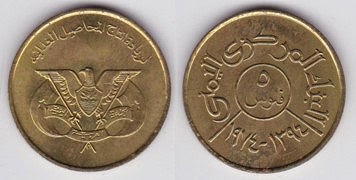
Ten Fils – Yemen Arab Republic - Brass - 1974


25 Fils – Yemen Arab Republic - Cupro Nickel - 1974


Fifty Fils – Yemen Arab Republic - Cupro Nickel - 1985


One Riyal – Yemen Arab Republic - Cupro Nickel - 1978


My Collection of Republic of Yemwn Coins


Five Riyals – Republic of Yemen - Steel - 1993


Ten Riyals – Republic of Yemen - Steel - 1995


Twenty Riyals – Republic of Yemen - Steel - 2006


Note - Some of the images of coins in my collection, have been taken from the Gallery to the extent available, to save on time & effort involved in photography & editing.